
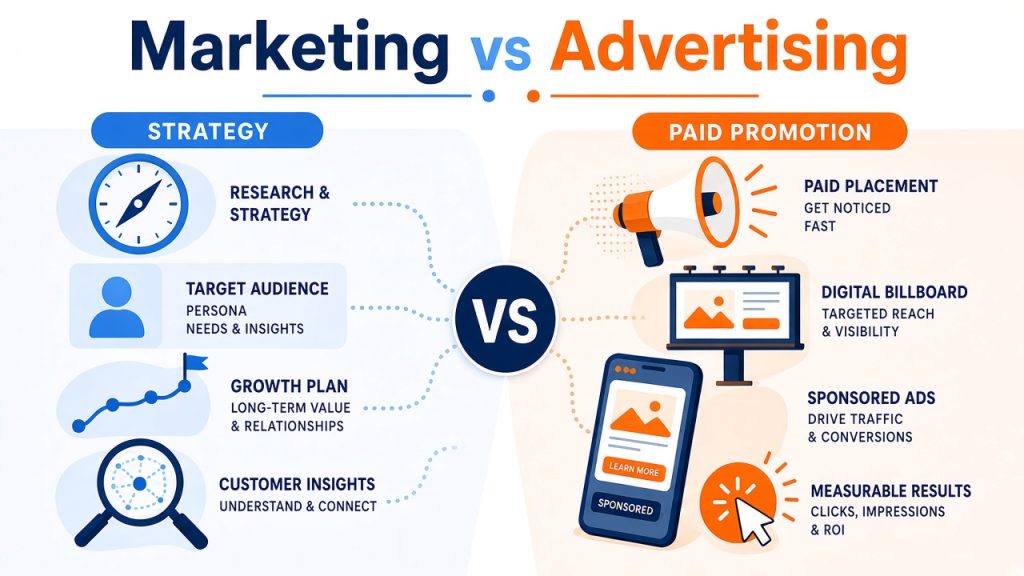
You run a sweet shop in Vadodara, a textile unit in Surat, or a small export business in Veraval. Someone tells you, “You need marketing.” Someone else says, “Just run some ads.” Both sound right, both cost money, and it is hard to know where to start.
Here is the short answer: advertising is one part of marketing, not a replacement for it. Understanding the difference can save you from spending on ads that bring clicks but no customers. In this post, we’ll break it down in plain language, with examples from everyday local business life, and help you decide what to focus on first.
At VeravalOnline, our digital marketing services cover both the foundation and the paid promotion that sits on top of it.
What Is Marketing?
Marketing is everything you do to understand your customers and bring your product or service to them in a way that makes them want to buy and come back. It is the big picture.
Marketing includes:
- Knowing your customer – who they are, what they need, and where they look for it.
- Your product and pricing – what you sell and how you position it.
- Your brand – your name, logo, packaging, shop look, and the way you talk to people.
- Your online presence – your website, Google Business Profile, and social media pages.
- Content and relationships – helpful posts, WhatsApp updates, reviews, and after-sales service.
- Advertising – yes, ads sit inside marketing.
Think of marketing as the entire journey: from a stranger hearing about you, to becoming a loyal customer who recommends you to friends.
What Is Advertising?
Advertising is paid communication to promote your business, product, or offer. You pay for space or attention – a newspaper ad, a hoarding near the highway, a radio spot, a Google search ad, or a sponsored Instagram post.
Advertising is usually:
- Paid – you spend money for every view, click, or placement.
- Time-bound – a Diwali sale campaign, a new-branch launch, a monsoon offer.
- Fast – it can bring attention quickly, but it stops when the budget stops.
In simple words: marketing is the strategy; advertising is one of the tools you use to carry out that strategy.
Key Differences Between Marketing and Advertising
- Scope – Marketing is the complete process (research, brand, product, pricing, website, content, customer service). Advertising is one part of that: paid promotion.
- Goal – Marketing builds long-term trust, demand, and loyal customers. Advertising creates quick awareness or drives action for a specific offer.
- Cost – Marketing mixes free and paid activities (SEO, content, social posts, reviews). Advertising is always paid (ad spend plus creative cost).
- Timeline – Marketing is ongoing and builds results over months. Advertising is campaign-based and works while the ad runs.
- Examples – Marketing includes your website, SEO, Google Business Profile, packaging and social content. Advertising includes Google Ads, Facebook/Instagram ads, newspaper ads and hoardings.
- Control of message – Marketing is shaped by what you do and what customers say about you. Advertising is fully controlled by you.
How Marketing and Advertising Work Together
Marketing and advertising work best as a team. Advertising brings people to your door; marketing makes sure they like what they see once they arrive.
Here are some relatable examples:
1. The restaurant in Vadodara
A restaurant runs an Instagram ad for its new weekend thali. The ad gets attention. But when people search the restaurant’s name on Google, they find no website, old photos, and an outdated phone number. Many give up. With good marketing in place – an updated Google Business Profile, a simple website with the menu, and fresh photos – the same ad turns into actual table bookings.
2. The hardware store in Gujarat
A hardware shop pays for Google search ads for “plumbing supplies near me.” Clicks come in, but the landing page is slow and does not show the products or the shop’s address clearly. Visitors leave. When the business invests in a fast, mobile-friendly website (marketing), the ad money starts paying off.
3. The packaged-food brand
A local namkeen brand gets shelf space in supermarkets. Without attractive packaging and clear labelling, buyers pick the familiar brand next to it. Good packaging design is marketing. Running a festive offer on social media is advertising. Together, they help the product get noticed and picked up.
The pattern is clear: ads without a solid marketing foundation leak money. A strong foundation makes every rupee of ad spend work harder.
Which Should You Focus On First?
For most small and medium businesses, the honest answer is: build your marketing foundation first, then add advertising to speed things up.
Here are practical steps:
1. Get your basics right
- Have a clean, mobile-friendly website that clearly shows what you offer, where you are, and how to contact you (phone, WhatsApp, email).
- Make sure your website loads quickly and is secure (HTTPS).
- Claim and update your Google Business Profile with correct timings, photos, and address.
2. Make it easy to be found
- Work on basic SEO: use the words customers actually search, such as “AC repair in Vadodara” or “wedding caterers in Gujarat.”
- Keep your business name, address, and phone number consistent everywhere online.
3. Build trust with content
- Post helpful, real content on social media – behind-the-scenes, customer questions, new arrivals.
- Ask happy customers for Google reviews and reply to every review politely.
4. Then start advertising – small and focused
- Start with a small, fixed budget on one channel (for example, Google search ads for local searches).
- Target your city or area instead of all of India.
- Send people to a relevant page on your website, not just the home page.
- Track calls, WhatsApp messages, and enquiries so you know what is working.
5. Review and improve every month
- Check which ads, posts, and pages bring real enquiries.
- Stop what doesn’t work, and put more into what does.
When to start with ads first? If you have a short, time-sensitive offer – a festive sale, an event, or a new launch – advertising can make sense right away. Even then, make sure your website and contact details are ready to receive those customers.
How VeravalOnline Helps
VeravalOnline Private Limited, based in Vadodara and operating since 2008, works with businesses on both sides of the equation – building the foundation and helping promote it.
- Website and app development – business websites, web applications, and iOS and Android apps, including eCommerce stores and WordPress websites.
- Custom design – store design, packaging design, and brand visuals such as banners and graphics.
- Hosting and website care – WordPress-ready hosting with domain and SSL setup and backups, plus help with uptime, security checks, and technical fixes.
- Search engine optimization (SEO) – on-page and off-page SEO, content creation, site structure, and monthly reports.
- Digital marketing – social media marketing, content marketing, local marketing, reputation management, and pay-per-click advertising.
- Webmaster services – a monthly team for website updates, design, social media, SEO, digital marketing, and hosting coordination.
- Dedicated resources – developers, designers, and marketers available on a full-time or project basis.
So whether you need a new website, better visibility on Google, or a well-planned ad campaign, you can work with one team that understands how all the pieces fit together.
Conclusion
Marketing and advertising are not rivals. Marketing is the full plan for attracting and keeping customers; advertising is a paid tool that speeds up part of that plan. For most small and medium businesses in Gujarat, the smartest path is to build a strong foundation – a good website, local visibility, and trust – and then use focused advertising to grow faster.
Ready to build a strong online presence and make your marketing budget count? Get in touch with VeravalOnline today. Visit veravalonline.com or reach out through the contact page to talk about your website, SEO, or digital marketing needs.
Frequently Asked Questions
1. Is advertising a part of marketing?
Yes. Advertising is one part of marketing. Marketing covers research, branding, your website, content, and customer relationships, while advertising is the paid promotion within that plan.
2. Can a small business do marketing without spending on ads?
Yes. A good website, SEO, an updated Google Business Profile, regular social media posts, and customer reviews are all marketing activities that don’t require ad spend, though they do need time and effort.
3. Should I start with Google Ads or social media ads?
It depends on how your customers find you. If people search for your service (“plumber near me”), Google search ads are a good fit. If your product is visual or impulse-driven, like food or fashion, social media ads may work better. Start small and track the results.
4. Why do I need a website if I already run ads?
Ads bring people to you, but your website is where they decide whether to trust you. A clear, fast, mobile-friendly website helps turn ad clicks into calls, enquiries, and sales.
Your Business. Our Technology.
VeravalOnline Private Limited
We Aim, Your Success.
Since 2008
📍 312 Broadway Signature, Sevasi Canal Road, Vadodara – 391101, Gujarat, India
📞 +91 78630 42495
📧 [email protected]
🌐 www.veravalonline.com







Leave a Reply
You must be logged in to post a comment.